Imagine asking your business system to "optimize inventory levels" and having it automatically analyze sales velocity, predict stockouts, check supplier availability, create purchase orders, adjust product visibility on your store, and report back—all without manual intervention. This isn't traditional AI following rigid instructions. This is agentic AI—artificial intelligence that sets goals, plans multi-step actions, and executes autonomously with minimal human oversight.
While conversational AI like ChatGPT responds to what you ask, agentic AI pursues what you need. It represents a fundamental shift from AI that responds to commands to AI that achieves objectives. Rather than just generating a response, agentic AI systems can analyze complex situations, develop strategies, execute actions across multiple systems, and learn from outcomes—operating continuously across extended timeframes.
The transformation is happening now. Nearly 79% of large enterprises have already adopted AI agents, with 96% planning to expand implementations in 2025. Major organizations from the FDA to Fortune 500 retailers are deploying autonomous systems that handle regulatory work, customer service, supply chain optimization, and operational decision-making. The agentic AI market is projected to grow from $5.25 billion in 2024 to $61.75 billion by 2030—a 43.84% compound annual growth rate that signals a fundamental shift in how businesses operate.
This guide explains what makes agentic AI different from traditional automation and generative AI, how these systems work, where they're being deployed across industries, and how businesses—especially in ecommerce—can harness their potential without technical complexity. Whether you're evaluating AI investments, implementing automation, or simply trying to understand where the technology is headed, this article provides the foundation you need to make informed decisions.
What is agentic AI?
Agentic AI refers to artificial intelligence systems that can accomplish specific goals with limited human supervision by autonomously making decisions, taking actions, and adapting to changing conditions. Unlike traditional AI systems that operate within predefined constraints and require constant human intervention, agentic AI demonstrates agency—the capacity to act independently and purposefully toward objectives.
The term "agentic" distinguishes these systems from their predecessors in critical ways. Traditional AI follows rigid instruction sets: if X happens, then do Y. Generative AI creates content based on prompts: given this input, produce that output. Agentic AI pursues outcomes: here's the goal, determine the best path and execute it. This autonomy enables systems to maintain long-term goals, manage multi-step problem-solving tasks, and track progress over extended periods—hours, days, or ongoing.
Built on large language models (LLMs) and generative AI capabilities, agentic AI extends far beyond content generation into orchestration and execution. These systems combine the reasoning power of LLMs with the ability to interact with external tools—calling APIs, querying databases, searching the web, and coordinating actions across multiple platforms. While a generative model might draft an email campaign, an agentic system analyzes customer segments, generates personalized campaigns for each, schedules optimal send times, monitors performance, and adjusts messaging based on real-time results.
The distinguishing characteristics that define agentic AI include:
- Goal-oriented behavior: Working toward objectives rather than just completing isolated tasks
- Multi-step reasoning and planning: Breaking complex goals into executable strategies
- Tool use and system interaction: Ability to call external systems, access real-time data, and execute actions
- Learning and adaptation: Incorporating feedback to improve future performance
- Extended operation: Functioning across timeframes that span hours, days, or continuous monitoring
Agentic AI vs Generative AI: What's the Difference?
Understanding the relationship between generative AI and agentic AI is essential for grasping where the technology is headed. Agentic AI is a subset of generative AI that goes beyond content creation to autonomous action and goal achievement.
Generative AI Capabilities
Generative AI systems, powered by large language models, excel at creating content based on learned patterns. They can generate text, images, code, and music in response to prompts. The value comes from what the model can produce—whether that's drafting an email, writing code, or creating product descriptions. Generative AI can also perform simple function calling and chain together various options, but it fundamentally remains focused on responding to inputs rather than pursuing outcomes.
When you ask ChatGPT to write a marketing email, it generates text based on patterns it learned during training. It doesn't send the email, monitor its performance, or adjust your strategy based on results. The system creates output, and you decide what to do with it.
Agentic AI Capabilities
Agentic AI uses LLMs as a "brain" to orchestrate actions toward specific goals. Rather than just generating content, these systems execute multi-step workflows autonomously, interact with external systems through APIs and databases, make decisions based on real-time data, and work toward higher-level objectives across extended timeframes.
The critical distinction is this: generative AI creates, while agentic AI achieves. Generative AI produces outputs; agentic AI produces outcomes.
Concrete Examples of the Difference
Marketing Scenario:
- Generative AI: Creates three email campaign variations when you ask
- Agentic AI: Analyzes customer segments, generates personalized campaigns for each, schedules optimal send times, monitors open rates, automatically adjusts messaging based on performance, and reports on ROI
Ecommerce Scenario:
- Generative AI: Writes product descriptions when given product specifications
- Agentic AI: Monitors inventory levels, analyzes sales velocity and seasonality, automatically adjusts product visibility, triggers reorder workflows when thresholds are met, optimizes pricing based on demand, and coordinates with shipping logistics
In both cases, the agentic system uses generative AI capabilities as one tool among many to achieve its goals. The generative component creates the text, but the agentic orchestration determines what to create, when to send it, how to optimize it, and what actions to take based on results.
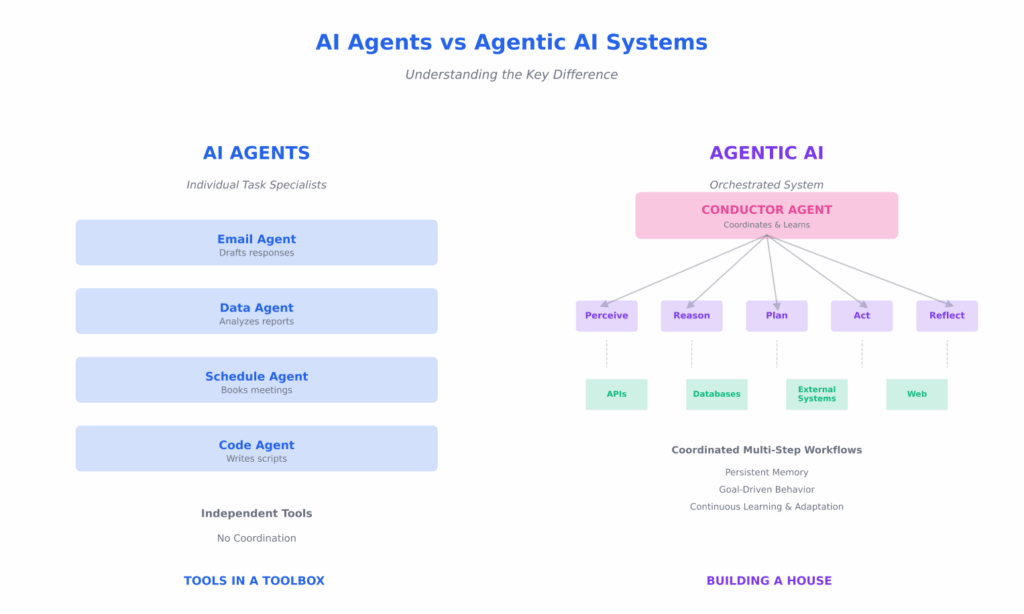
Figure 1: The Key Distinction - AI agents are individual tools in a toolbox, while agentic AI is the coordinated use of those tools to build a house. Agentic systems use conductor models to orchestrate multiple specialized agents toward complex goals.
AI Agents vs Agentic AI Systems
While the terms "AI agents" and "agentic AI" are often used interchangeably, understanding the distinction helps clarify how these systems work and scale.
AI agents are individual autonomous entities designed for specific tasks. They're the building blocks—specialized tools that can operate independently within their domain. An AI agent might monitor Help Scout tickets and automatically tag them by category, or draft email responses based on common customer inquiries, or analyze sales data to generate reports. Each agent performs its designated function reliably and autonomously.
Agentic AI systems, in contrast, represent the coordinated orchestration of multiple agents working toward complex objectives. Rather than isolated tools, you have an integrated system where agents collaborate, share context, and coordinate actions. The whole becomes greater than the sum of its parts.
Think of it this way: AI agents are individual instruments in an orchestra—the violin, trumpet, and drums can each play independently. Agentic AI is the full orchestral performance, with a conductor coordinating all instruments toward a cohesive musical goal. The conductor agent oversees the system, while specialized agents handle specific tasks.
Single Agent Example
An AI agent that monitors your helpdesk and automatically tags incoming support tickets by category (billing, technical, shipping) based on their content. It performs one function reliably, with no coordination needed.
Multi-Agent Agentic System Example
A customer service system where:
- Agent 1 categorizes incoming requests
- Agent 2 searches knowledge bases for relevant solutions
- Agent 3 drafts personalized responses using customer history
- Agent 4 escalates complex issues to humans with full context
- Conductor agent coordinates the workflow, maintains conversation state, and learns which routing decisions produce the best outcomes
This coordination enables the system to handle nuanced customer interactions that require multiple capabilities working together, with the conductor ensuring coherent flow and continuous improvement.
Architectural Patterns
Agentic AI systems typically employ one of two primary architectures, each with distinct advantages:
Hierarchical (Vertical): A conductor model powered by an LLM oversees tasks and supervises simpler, specialized agents. This architecture works well for sequential workflows where tasks have clear dependencies. The downside: it can create bottlenecks if the conductor becomes overwhelmed.
Horizontal (Decentralized): Agents work as equals in a decentralized fashion, coordinating peer-to-peer. This approach is more resilient—if one agent fails, others continue functioning—but can be slower than hierarchical systems and requires sophisticated coordination mechanisms.
The choice of architecture depends on your application's needs. Sequential, dependent tasks favor hierarchical structures. Parallel, independent tasks benefit from horizontal coordination.
How Does Agentic AI Work?
Agentic AI operates through a continuous cycle that mirrors human problem-solving at scale. Rather than executing a single task and stopping, these systems cycle through perception, reasoning, planning, action, and reflection—continuously adapting and improving over time.
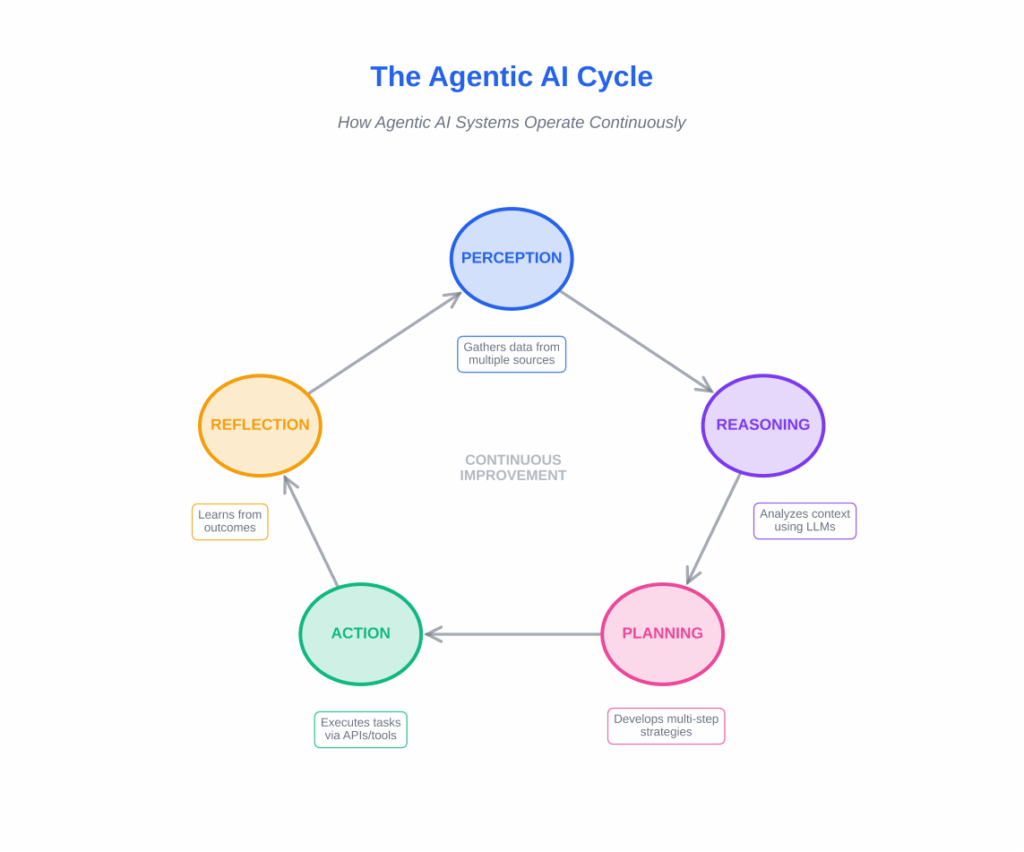
Figure 2: The Agentic AI Cycle - A continuous loop of perception, reasoning, planning, action, and reflection enables autonomous decision-making and continuous improvement.
The Five-Stage Agentic Cycle
1. Perception
Agentic systems begin by gathering information from their environment. This isn't passive data collection—it's active monitoring across multiple sources: databases, APIs, sensors, user interfaces, web searches, and connected systems. Unlike traditional systems that only access pre-loaded datasets, agentic AI can reach out to external systems in real-time to gather the context it needs.
Example: An ecommerce agentic system continuously monitors Shopify order data, inventory levels via supplier APIs, shipping carrier tracking information, customer service ticket sentiment, and competitor pricing—all simultaneously. It perceives the full state of your business environment, not just isolated data points.
2. Reasoning
The system uses large language models to analyze the gathered data, understand context, identify relationships between disparate information sources, and formulate potential solutions. This reasoning capability allows the system to handle nuanced, context-dependent situations that would overwhelm rule-based automation.
Example: Analyzing that shipping delays are correlated with specific carriers during weather events, and that high-value customers are disproportionately affected. The system recognizes patterns a human might miss when looking at each data source in isolation.
3. Planning
Based on its reasoning, the AI develops multi-step strategies to achieve defined goals. It breaks down complex objectives into manageable subtasks, determines optimal sequencing and timing, considers constraints and available resources, and anticipates potential obstacles. This planning capability is what enables agentic systems to handle workflows that previously required human oversight.
Example: Creating a comprehensive response plan: (1) Notify affected customers with personalized messages acknowledging their status, (2) Apply discount codes to impacted orders as service recovery, (3) Switch future high-value shipments to more reliable carriers, (4) Negotiate with alternative carriers for priority handling. Each step is sequenced to minimize customer impact while maintaining operational efficiency.
4. Action
The system executes its plan by interacting with external systems and tools. It calls APIs to retrieve or update data, triggers workflows in connected applications, makes decisions within defined parameters and guardrails, coordinates actions across multiple platforms, and operates with appropriate authorization levels. This is where agentic AI transcends analysis and actually changes business state.
Example: Automatically sending personalized shipping delay notifications via email (Klaviyo API), applying 15% discount codes to affected orders (Shopify API), changing shipping method for pending high-value orders from USPS to FedEx (ShipStation API), and sending Slack alerts to the operations team with summary of actions taken.
5. Reflection
After taking action, the system evaluates outcomes and learns. It assesses whether actions achieved desired results, identifies what worked and what didn't, adjusts future behavior based on lessons learned, improves decision-making accuracy over time, and maintains performance metrics. This reflection loop is what enables true autonomy—the system doesn't just execute, it gets better at execution.
Example: Tracking whether the carrier switch actually reduced delays for subsequent shipments, monitoring if customer satisfaction scores improved for those who received proactive notifications, calculating the ROI of service recovery discounts versus potential churn, and adjusting future shipping rules based on which interventions proved most effective.
The Continuous Nature
This isn't a one-time process. Agentic AI systems cycle through these stages continuously, maintaining long-term goals while adapting to changing conditions. The system that handled your shipping crisis doesn't stop after sending notifications—it continues monitoring carrier performance, adjusting rules, and optimizing decisions based on accumulating evidence.
The key components that make this work include:
- LLMs provide reasoning capabilities and natural language understanding
- Tool integration enables real-world action beyond analysis
- Memory systems maintain context and state across sessions
- Feedback loops enable continuous improvement through learning
Key Components and Capabilities
Agentic AI systems demonstrate several distinguishing capabilities that set them apart from traditional automation and even generative AI. Understanding these components helps clarify what makes these systems "agentic" and why they represent a meaningful evolution in artificial intelligence.
Autonomy
The most fundamental characteristic is the ability to operate without constant human oversight. Agentic systems can maintain long-term objectives across extended timeframes—hours, days, or continuous operation. They manage multi-step problem-solving independently, make decisions within defined parameters, and only escalate to humans when they encounter situations outside their scope or authority.
This autonomy doesn't mean "set and forget." Rather, it shifts human involvement from hands-on execution to strategic oversight. Instead of manually processing each order, you define business rules and goals, then let the system handle execution while you monitor performance and adjust objectives.
Example: A 24/7 inventory optimization system that monitors stock levels, predicts demand fluctuations, adjusts reorder points automatically, and only notifies humans when supplier issues require negotiation or when unusual patterns suggest the need for strategic review.
Proactive Decision-Making
Agentic systems don't wait for explicit instructions—they anticipate needs and act based on goals. This proactivity comes from combining the flexibility of LLMs (which can generate responses based on nuanced, context-dependent understanding) with structured, deterministic features of traditional programming. The result: agents that can "think" about situations and "do" something about them in a more human-like fashion.
Example: Detecting emerging fraud patterns and automatically implementing additional verification steps for suspicious orders before they ship, rather than waiting for chargebacks and then reacting.
Tool Use and Integration
LLMs by themselves can't directly interact with external systems, but agents can. They call APIs to interact with applications, query databases for real-time information, search the web when needed, coordinate actions across multiple platforms, and use this information to make decisions and take actions. This capability to reach beyond their training data and access live systems is what enables agents to operate in dynamic, real-world environments.
Example: A MESA workflow that pulls order data from Shopify, checks supplier inventory via API, updates Google Sheets tracking, sends Slack notifications to the team, and triggers email campaigns in Klaviyo—all coordinated as a single agentic process.
Specialization and Orchestration
Not all agents are created equal. Some are simple, performing single repetitive tasks with high reliability. Others are complex, using perception and memory to solve sophisticated problems. The most advanced systems use hierarchical architectures where a conductor model coordinates multiple specialized agents.
Different architectures suit different needs. Hierarchical systems (conductor overseeing specialized agents) work well for sequential workflows but can create bottlenecks. Horizontal systems (agents working as peers) offer more resilience but require sophisticated coordination. The key is matching architecture to your application's requirements.
Adaptability
Agents learn from experience and feedback, adjusting their behavior over time. With appropriate guardrails to ensure safe operation, agentic systems can improve continuously. Multi-agent systems possess the scalability to eventually handle increasingly broad initiatives as they accumulate knowledge and refine their decision-making.
This adaptability distinguishes agentic AI from static automation. Traditional workflow automation executes the same steps every time. Agentic systems adjust based on what works, becoming more effective as they operate.
Natural Language Interface
Because agentic systems are powered by LLMs, users can engage with them through natural language prompts rather than complex user interfaces. This dramatically reduces the learning curve and democratizes access to sophisticated automation. Instead of mastering multiple software platforms with their tabs, dropdowns, charts, sliders, and pop-ups, you can simply describe what you want to achieve and let the agent figure out execution.
The productivity benefit is substantial. Workers spend significant time learning and mastering new interfaces and tools. When you can interact with systems conversationally—just "talking" with an agent who fetches information and takes action—that friction disappears.
Real-World Applications of Agentic AI
Agentic AI is being deployed across industries to automate complex processes that previously required constant human attention. These aren't experimental proofs of concept—they're production systems handling critical business functions.
Ecommerce and Retail
The ecommerce sector faces unique operational complexity: inventory across multiple channels, dynamic pricing pressures, fraud risks, and customer service demands that scale with volume. Agentic AI addresses these challenges through:
- Dynamic inventory management: Systems that monitor sales velocity, predict stockouts using seasonality and trending data, automatically adjust reorder points, coordinate with suppliers via API, and optimize stock distribution across fulfillment centers
- Personalized customer journeys: Agents that analyze individual behavior patterns, deliver tailored product recommendations, adjust messaging based on engagement, and coordinate across email, SMS, and web channels in real-time
- Automated fraud prevention: Systems that detect suspicious patterns, flag high-risk orders before fulfillment, coordinate with payment processors and shipping providers, and learn which signals indicate genuine fraud versus false positives
- Supply chain optimization: End-to-end coordination from supplier to customer, with predictive adjustments for disruptions, automated routing decisions, and real-time visibility
MESA Example: A MESA agentic workflow monitors your Shopify store continuously. When a product starts trending, it automatically increases inventory orders from suppliers, adjusts Facebook Ads spending to capitalize on momentum, creates urgency messaging ("Only 12 left!") on the product page, notifies your fulfillment team of expected volume spikes, and prepares customer service with FAQs about the trending product—all coordinated without manual intervention. The system acts as your operational intelligence layer.
Customer Service
Customer service represents one of the earliest and most successful deployments of agentic AI. These systems handle inquiry resolution autonomously, maintain context across interactions, route complex issues intelligently, and continuously improve their knowledge base based on which responses prove most effective.
Major deployments include the FDA using agentic AI for regulatory inquiries, the UK's Staffordshire Police trialing agent systems for non-emergency calls, and the IRS implementing Salesforce Agentforce for taxpayer services. These aren't customer-facing chatbots—they're sophisticated systems that analyze inquiries, search knowledge bases, consult relevant regulations or policies, draft responses, and escalate appropriately.
Supply Chain and Logistics
Supply chain management faces unprecedented volatility from trade disruptions, climate events, regulatory changes, and workforce shifts. Agentic AI serves as an intelligent co-pilot that interprets planning results, compares them with real-time data from quality events, monitors inventory thresholds and anomalies, triggers alternative planning scenarios, and suggests actions to planners.
These systems perform end-to-end demand forecasting, autonomous logistics optimization, real-time adjustments for supply chain disruptions, predictive maintenance and resource allocation, and coordination across suppliers, warehouses, and transportation providers. The World Economic Forum highlights how agentic AI is revolutionizing supply planning by enabling data-driven decisions that account for complex interdependencies humans struggle to process.
Healthcare
Healthcare applications focus on augmenting professional expertise rather than replacing clinical judgment. Agentic systems assist with diagnostic support by analyzing medical records and research literature, treatment planning based on patient history and clinical trials, drug discovery through research synthesis and pattern recognition, and administrative automation for compliance documentation and regulatory reporting.
The key is appropriate scope: agents handle information processing, pattern recognition, and documentation while doctors make final clinical decisions. This division of labor allows physicians to focus on complex judgments while agents handle time-consuming information synthesis.
Financial Services
Financial institutions deploy agentic AI for automated fraud detection with sophisticated pattern recognition, risk assessment across investment portfolios, investment strategy optimization based on market conditions, and regulatory compliance monitoring with real-time alerting. These applications leverage agents' ability to analyze vast amounts of data, identify subtle correlations, and take protective actions within microseconds.
Software Development
Development teams use agentic AI for automated code generation and debugging, continuous testing and quality assurance, documentation generation that stays current with code changes, and DevOps workflow optimization. Tools like GitHub Copilot have evolved from code completion to true coding agents that can understand requirements, implement features, test code, and iterate based on results.
The Common Thread: Across all these applications, agentic AI doesn't just automate simple tasks—it handles complex, multi-step processes that continuously sense, plan, act, and improve. These systems maintain context over time, coordinate across multiple tools and platforms, and adapt based on outcomes.
Current State and Enterprise Adoption
The adoption of agentic AI has accelerated dramatically in 2024-2025, moving from experimental deployments to mainstream business infrastructure. The statistics tell a compelling story of rapid transformation.
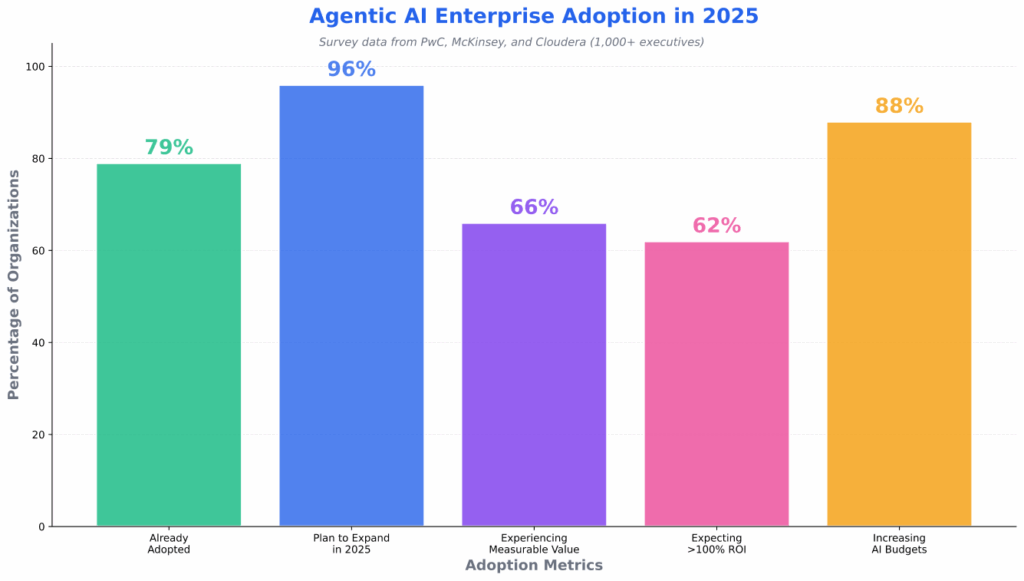
Figure 3: Enterprise Agentic AI Adoption in 2025 - Survey data from PwC, McKinsey, and Cloudera shows strong adoption momentum across key metrics. (Sources: PwC 2025 AI Agent Survey - 308 executives; McKinsey State of AI 2025 - 1,993 participants across 105 countries; Cloudera Enterprise Survey - 1,484 IT decision-makers)
Adoption Metrics
Recent surveys reveal adoption patterns that exceed typical enterprise technology rollouts:
- 79% of organizations report having adopted AI agents at some level, with only 2% indicating no plans or interest
- 96% of IT leaders plan to expand their AI agent implementations during 2025, signaling sustained investment momentum
- 88% of organizations are increasing their AI-related budgets in 2025 specifically due to agentic AI capabilities
- 23% are actively scaling agentic AI systems across their enterprises, expanding deployment beyond pilots
- 39% are experimenting with AI agents, testing use cases and building capabilities
These aren't aspirational numbers—they represent actual deployments. The vast majority (88%) of survey respondents say their organizations are using AI regularly in at least one business function.
From Pilot to Production
Organizations are moving beyond experimentation to real deployment:
- The FDA deployed agentic AI capabilities for regulatory staff to support pre-market reviews, validation, post-market surveillance, inspections, and compliance work
- Salesforce Agentforce is being adopted by the IRS for taxpayer services and UK police for handling non-emergency calls
- Major cloud providers including AWS, Google Cloud, and IBM are offering enterprise agent platforms with governance, security, and scalability features
- Notable companies including Walmart are deploying "super-agents" for operational coordination
Industry-specific deployments are emerging across sectors: fraud detection and risk analysis in finance, supply chain optimization and quality control in manufacturing, personalization and demand forecasting in retail, diagnostic support and medical research in healthcare.
Measured Value and ROI
Organizations deploying agentic AI report concrete business impact:
- 66% experiencing measurable value through increased productivity
- 62% expect ROI exceeding 100% from their agentic AI deployments
- 57% report cost savings from workflow automation and efficiency gains
- 55% report faster decision-making due to real-time analysis and action
- 54% report improved customer experience from more responsive, personalized interactions
Companies adopting agentic AI report average revenue increases of 6-10%, demonstrating tangible business impact beyond operational efficiency.
The Challenge: Security and Governance
While adoption accelerates, implementation often runs ahead of appropriate guardrails. Survey data reveals concerning gaps:
- 79% of organizations have deployed agents without written policies governing their use
- 41% have security concerns about their current IAM (Identity and Access Management) infrastructure handling autonomous systems
- 47% of enterprise AI users made at least one major decision based on hallucinated (incorrect) AI content in 2024
This creates risk. Autonomous systems need robust identity management, clear authorization boundaries, audit trails for actions taken, escalation paths for edge cases, and human oversight for high-stakes decisions. Organizations rushing to deploy without these safeguards expose themselves to operational, reputational, and security risks.
The good news: awareness is high. Organizations recognize these challenges and are actively working to establish governance frameworks, implement security controls, and develop best practices. The technology has proven its value; now the focus shifts to responsible, scalable deployment.
What This Means
Agentic AI has moved from cutting-edge to mainstream faster than most enterprise technologies. The question is no longer "Should we explore this?" but rather "How do we implement this thoughtfully?" Organizations that act now—with appropriate guardrails and clear objectives—position themselves to capture competitive advantage. Those that wait risk falling behind competitors who are already multiplying their operational capabilities through intelligent automation.
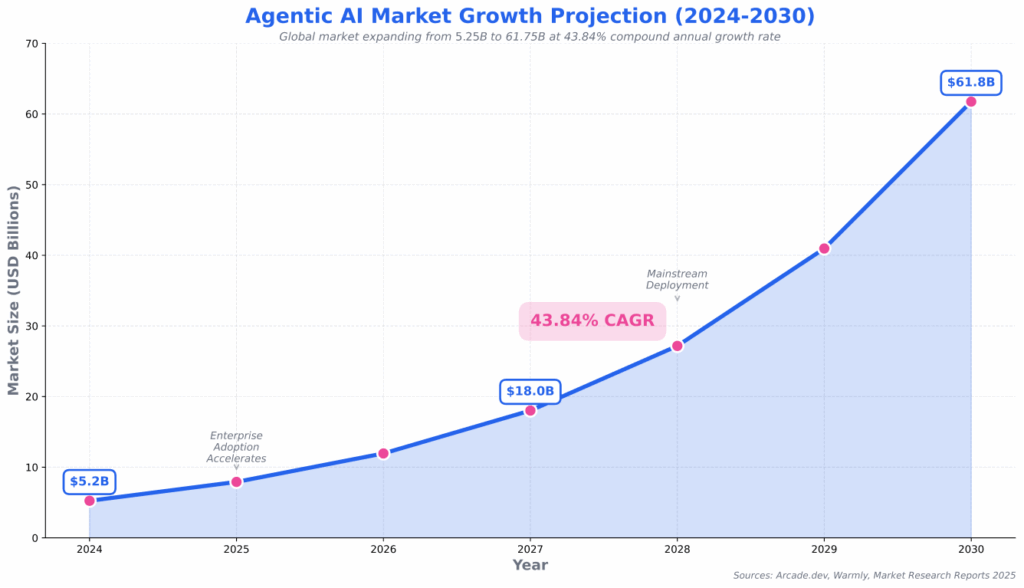
Figure 4: Explosive Market Growth - The agentic AI market is projected to grow from $5.25 billion in 2024 to $61.75 billion by 2030, representing a 43.84% compound annual growth rate as enterprises rapidly adopt autonomous AI systems. (Sources: Arcade.dev, Warmly, Market Research Reports 2025)
Building Agentic AI: Challenges and Considerations
Building agentic AI systems traditionally requires significant technical expertise and organizational change management. Understanding these challenges helps set realistic expectations and plan for successful implementation.
The Traditional Technical Approach
Conventional agentic AI implementation demands:
- Deep technical expertise in LLMs, orchestration frameworks, and agent architectures
- Custom code for tool integration, workflow coordination, and error handling
- Infrastructure for agent coordination, monitoring, and performance tracking
- Ongoing maintenance, refinement, and scaling as business needs evolve
This technical lift puts agentic capabilities out of reach for many organizations, particularly small teams and individual professionals who could benefit most from multiplying their operational capacity.
Key Implementation Challenges
1. Defining Clear Objectives
Agentic systems need specific, measurable goals. Vague instructions like "improve customer satisfaction" lead to unpredictable behavior. Effective objectives are concrete: "Respond to support tickets within 2 hours with >90% accuracy" or "Maintain bestseller inventory above 20 units at all times." Translating business outcomes into precise agent parameters requires careful thought about what success actually looks like.
2. Data Quality and Access
Agents are only as good as the data they access. They require structured, accurate, well-maintained data sources, proper API integrations across systems, real-time access where decisions depend on current state, and data pipelines that ensure information flows reliably. Poor data quality doesn't just reduce agent effectiveness—it can cause agents to make actively harmful decisions based on incorrect information.
3. Security and Governance
Autonomous systems require robust guardrails. This includes identity and access management that controls what actions agents can take, audit trails and explainability so you understand why agents made specific decisions, compliance mechanisms that ensure agents respect regulations and policies, and approval workflows for high-stakes decisions that shouldn't be fully automated.
Organizations that deploy without these safeguards create risk. The 79% of companies running agents without written policies are gambling that nothing will go wrong—a dangerous bet when systems have the authority to spend money, communicate with customers, or make operational decisions.
4. Balancing Human Oversight
Finding the right level of human involvement is tricky. Too much oversight defeats the purpose of autonomy—you're essentially doing the work manually while the system watches. Too little oversight creates risk, especially during initial deployment when agents haven't proven reliability. The sweet spot: agents operate independently for routine decisions within defined parameters, escalate edge cases and high-stakes situations, maintain full audit trails so humans can review actions, and continuously improve based on human feedback on outcomes.
5. Scalability Planning
Start small, but design for growth. Initial deployments should be bounded in scope—one workflow, one department, clear success metrics. But the architecture should support expansion. As agents prove value, you'll want to add more capabilities, connect more systems, and coordinate more complex workflows. Planning for this trajectory from the start avoids costly rebuilds later.
6. Change Management
Technology challenges are often easier than organizational ones. Teams need to trust and understand agent behavior, which requires clear communication about what agents do and don't do, training on working alongside autonomous systems, adjustment of roles as agents handle routine work, and cultural shift from manual control to supervised autonomy. Resistance often comes from fear of job displacement or loss of control. Address this head-on: position agents as tools that handle tedious work so humans can focus on strategic judgment, creativity, and complex problem-solving.
Research from Boston Consulting Group found that successful AI transformations allocate 70% of their efforts to people, process, and culture—only 30% to technology. The human side determines whether agents succeed or fail.
Agentic AI Best Practices
Successfully implementing agentic AI requires strategic planning that balances ambitious goals with pragmatic execution. Organizations seeing the best results follow proven patterns.
1. Start with Well-Defined, Bounded Use Cases
Don't try to automate your entire business on day one. Choose processes with clear success metrics that are easy to measure, high volume and repetitive workflows where efficiency gains compound, bounded scope with limited decision complexity, and defined boundaries where escalation paths are obvious. Begin with one solid win, prove value, then expand. Early success builds organizational confidence and reveals patterns you can apply to additional use cases.
Example starting points: Order confirmation emails with tracking updates, inventory alerts when stock falls below thresholds, support ticket categorization and routing, or appointment scheduling and reminders.
2. Establish Clear Goals and Constraints
Define what success looks like in measurable terms—not "improve customer service" but "respond to 80% of tier-1 support tickets within 1 hour with >85% customer satisfaction." Set boundaries on agent authority: spending limits ("don't approve refunds over $100 without human review"), approval thresholds ("orders exceeding $500 require manual verification"), and action constraints ("never delete customer data, only archive"). Create escalation paths for edge cases the agent shouldn't handle autonomously.
These constraints aren't limitations—they're guardrails that enable agents to operate confidently within safe boundaries while flagging situations that need human judgment.
3. Invest in Data Infrastructure
Agents need reliable access to accurate data. Ensure clean, accessible, well-structured information with clear schemas and consistent formats, real-time data pipelines where decisions depend on current state, API integrations that are robust and well-documented, and data quality monitoring to catch issues before they cause agent errors. Bad data creates bad decisions. If your data infrastructure has gaps, address those before deploying agents that depend on that data.
4. Design for Transparency
Build systems where agent behavior is visible and understandable. Implement logging and audit trails that capture every action and the reasoning behind it, visibility into agent reasoning so stakeholders understand why decisions were made, dashboards for monitoring agent behavior, performance metrics, and errors, and explainability features that can justify decisions to customers or regulators. Transparency builds trust. When things go wrong (and they will occasionally), audit trails let you diagnose issues quickly and adjust accordingly.
5. Implement Appropriate Guardrails
Layer defenses to prevent agent mistakes from causing serious harm:
- Technical guardrails: Rate limits, validation checks, sandboxing for testing
- Ethical guardrails: Bias detection, fairness monitoring, privacy protection
- Business guardrails: Approval workflows for high-stakes decisions, spending limits, authority boundaries
These layers work together. Technical checks prevent obvious errors, ethical monitoring ensures fair treatment, and business rules keep agents within their intended scope.
6. Plan for Continuous Improvement
Agentic systems should get better over time. Establish feedback loops that connect outcomes to agent behavior, regular reviews of agent performance against defined goals, refinement of prompts, tools, and workflows based on results, and A/B testing for optimization when multiple approaches exist. Don't set and forget. The organizations seeing the best ROI actively manage and improve their agent systems based on operational learnings.
7. Maintain Human Expertise
Agents augment human capabilities; they don't replace human judgment. Keep humans engaged in oversight and system refinement, use agents to handle routine work while humans focus on complex decisions, and ensure domain experts guide agent development and governance. The goal isn't to eliminate human involvement—it's to elevate it. Let agents handle the predictable so humans can focus on the exceptional.
Agentic AI for Ecommerce Without Code
While building custom agentic systems traditionally required significant technical resources, new platforms are democratizing this capability. Individual professionals and small teams can now harness agentic AI without becoming engineers or managing infrastructure.
The Democratization of Agentic AI
MESA represents this shift toward accessible agentic automation. Rather than coding agent logic, orchestrating LLM calls, managing API integrations, and building monitoring systems, you describe what you want to achieve and let the platform handle execution. This accessibility matters because the businesses that could benefit most from agentic AI—small ecommerce operations, individual entrepreneurs, growing brands—often lack dedicated technical teams.
Natural Language Workflow Creation
Instead of writing code, describe your goals:
- "When inventory for bestsellers drops below 20 units, check supplier availability via API and automatically create purchase orders"
- "If a high-value customer hasn't ordered in 30 days, analyze their purchase history and send a personalized win-back offer with products they're likely to buy"
- "Monitor shipping carrier performance and automatically switch high-value orders to more reliable carriers when delays occur"
MESA's AI interprets intent and builds the multi-step workflow, handling the complexity of LLM orchestration, API coordination, error handling, and state management behind the scenes.
Pre-Built Agentic Templates
MESA provides ready-to-deploy workflows that demonstrate agentic behavior:
- Intelligent inventory management: Monitors sales velocity across channels, predicts stockout dates using seasonality and trending data, adjusts reorder points automatically based on supplier lead times, and triggers purchase orders or alerts based on defined thresholds
- Dynamic customer segmentation: Continuously analyzes purchase behavior, engagement patterns, and lifecycle stage, updates customer segments in real-time, triggers personalized campaigns based on segment changes, and optimizes messaging based on what works for each segment
- Automated fraud prevention: Detects suspicious order patterns (high value + new customer + expedited shipping), cross-references against fraud databases, flags orders for review before fulfillment, and learns which signals indicate real fraud versus false positives
- Post-purchase orchestration: Triggers review requests at optimal timing based on product type, schedules loyalty rewards when customers hit milestones, sends replenishment reminders for consumable products, and coordinates across email, SMS, and other channels
These templates encapsulate agentic patterns—goal-oriented, multi-step, adaptive—without requiring you to architect them from scratch.
Built-In Integration Ecosystem
Agents need to interact with multiple systems. MESA provides 100+ native integrations covering Shopify, shipping carriers, email platforms, customer service tools, payment processors, and analytics systems. API connectivity exists for custom integrations beyond pre-built connectors. Data transformation automatically happens between systems with different formats, and webhook triggers enable real-time responses to events.
This connectivity is essential. An agent that can analyze data but not take action is just reporting. An agent that can act across your full technology stack becomes genuinely useful.
Monitoring and Refinement
Visibility into agent behavior without technical overhead:
- Workflow execution logs showing each decision point and action taken
- Performance analytics showing automation impact on key business metrics
- A/B testing capabilities for optimization when multiple approaches exist
- Error handling and notification systems that alert you to issues
This transparency ensures you understand what agents are doing and can refine their behavior based on results—the reflection loop that enables continuous improvement.
The Advantage
MESA enables the benefits of agentic AI—autonomous, multi-step, goal-oriented workflows—without requiring you to become an AI engineer or manage infrastructure. You get agent capabilities with platform simplicity.
Example Workflow Breakdown
Goal: Maintain optimal inventory while minimizing overstock
Traditional approach: Manual spreadsheet analysis, regular supplier phone calls, manual purchase order creation—consuming hours weekly and prone to human error or delayed response
MESA agentic workflow:
- Continuously monitors sales data across all channels (Shopify, Etsy, retail if applicable)
- Analyzes seasonality and trending patterns using historical data
- Predicts stockout dates for each product based on current velocity
- Checks current supplier inventory availability via API
- Calculates optimal reorder quantities considering lead times and storage costs
- Creates purchase orders automatically or routes to manager for approval based on amount
- Notifies fulfillment team of incoming inventory with expected arrival
- Adjusts product visibility on store (hide out-of-stock items, promote overstocked items)
- Learns from past accuracy to improve future predictions
Result: Inventory levels optimized continuously without daily manual intervention, freeing you to focus on strategy, product development, and customer relationships rather than logistics spreadsheets.
The Future of Agentic AI
The rapid evolution of agentic AI suggests where the technology is headed and what capabilities will emerge in the coming years.
Increased Sophistication
Current agentic systems handle tasks spanning hours. The next generation—"frontier agents"—could work on complex projects for days with minimal human intervention. AWS and other providers are pushing boundaries toward agents that maintain context over extended periods, manage increasingly complex task decomposition, coordinate larger numbers of specialized sub-agents, and adapt to substantial environmental changes mid-task.
We'll see agents handling strategic projects that currently require dedicated human attention: comprehensive market research synthesis, complex supply chain redesigns, multi-channel campaign orchestration, and product development workflows.
Better Coordination and Interoperability
Standardized protocols are emerging to enable agent-to-agent communication across platforms. Anthropic's Model Context Protocol, LangChain's Agent Protocol, and Google's Agent2Agent represent efforts to create common languages for agent coordination. This standardization will enable agents from different vendors to work together seamlessly, share context across organizational boundaries with appropriate security, coordinate complex workflows spanning multiple platforms, and avoid proprietary lock-in.
Imagine your inventory agent coordinating with your supplier's fulfillment agent directly, negotiating delivery schedules and quantities without human intermediaries—that future requires interoperability standards now being developed.
Domain Specialization
As agents mature, expect increasing specialization. Rather than general-purpose systems, we'll see agents with deep expertise in particular domains: medical diagnosis agents trained on clinical literature, legal research agents understanding precedent and statutory interpretation, financial analysis agents with sophisticated market modeling, and supply chain agents with comprehensive logistics knowledge. These specialized agents will outperform generalists in their domains while still coordinating with other agents for comprehensive solutions.
Improved Trust and Explainability
Current agentic systems sometimes struggle with transparency—users don't always understand why agents made specific decisions. Future systems will provide better reasoning transparency showing step-by-step decision processes, confidence scores for recommendations and actions, alternative options considered and why they were rejected, and audit trails suitable for regulatory compliance. This explainability is critical for enterprise adoption, especially in regulated industries.
Hybrid Intelligence Models
The future isn't fully autonomous agents operating without oversight. It's more refined collaboration between human expertise and agent capabilities, with clearer boundaries on when human judgment is essential versus when agents can operate independently. We'll develop better frameworks for human-in-the-loop workflows, where agents handle routine execution but humans provide strategic direction, exception handling, and quality oversight.
The goal: combine the scale and consistency of agents with the judgment, creativity, and ethical reasoning of humans. Neither replaces the other; they complement.
For Ecommerce Specifically
Agentic AI will increasingly handle the operational complexity of running an online business. Individual entrepreneurs and small teams will compete with enterprise-level operations through intelligent automation that manages inventory across channels, coordinates personalized marketing at scale, optimizes pricing dynamically based on demand and competition, handles customer service inquiries with human-level quality, coordinates fulfillment and shipping logistics, and manages returns, refunds, and customer lifecycle. The competitive advantage shifts from those with the biggest teams to those who most effectively combine human expertise with intelligent automation.
The Shift
We're moving from "AI as a tool I use" to "AI as a colleague that handles entire domains of work." But always with appropriate human oversight for high-stakes decisions, strategic direction, and ethical judgment. The technology amplifies human capability; it doesn't replace human judgment. Organizations that embrace this partnership—using agents for scale and consistency while keeping humans focused on strategy and exceptions—will define the next era of business productivity.
Conclusion
Agentic AI represents a fundamental evolution in how businesses harness artificial intelligence. By moving from reactive tools that respond to commands to proactive systems that set goals, plan actions, and execute autonomously, agentic AI enables individuals and small teams to multiply their impact without scaling headcount.
The technology operates through continuous cycles of perception, reasoning, planning, action, and reflection—mimicking human problem-solving at scale while maintaining context over extended timeframes. What distinguishes agentic AI from traditional automation is its ability to adapt, learn from outcomes, coordinate across multiple systems, and pursue complex objectives that require multi-step reasoning.
Adoption is accelerating across industries. From the FDA deploying agents for regulatory work to retailers using autonomous systems for inventory optimization, from financial institutions automating fraud detection to healthcare organizations augmenting diagnostic support, agentic AI has moved from experimental to mainstream. The statistics underscore this momentum: 79% of enterprises have already adopted agents, 96% plan expansion in 2025, and the market is projected to grow from $5.25 billion to $61.75 billion by 2030.
While powerful, agentic AI requires thoughtful implementation. Organizations must define clear objectives, ensure data quality, establish governance frameworks, balance human oversight appropriately, and plan for continuous improvement. The companies seeing the best results treat agents as tools that augment human expertise rather than replace human judgment—letting agents handle predictable, high-volume work while humans focus on strategy, creativity, and complex decision-making.
Platforms like MESA are democratizing access to agentic capabilities, making sophisticated automation available to businesses without technical teams. Through natural language workflow creation, pre-built templates, comprehensive integrations, and transparent monitoring, individual entrepreneurs and small teams can harness agent capabilities that previously required dedicated engineering resources.
The opportunity is clear: as agentic AI platforms mature and adoption spreads, the competitive advantage shifts from those with the biggest teams to those who most effectively combine human expertise with intelligent automation. Organizations that act now—with clear goals, appropriate guardrails, and strategic focus—position themselves to capture this advantage.
Ready to multiply your operational capacity? Agentic AI isn't science fiction or the distant future—it's available today. The question is whether you'll harness it to rethink how work gets done in your business.